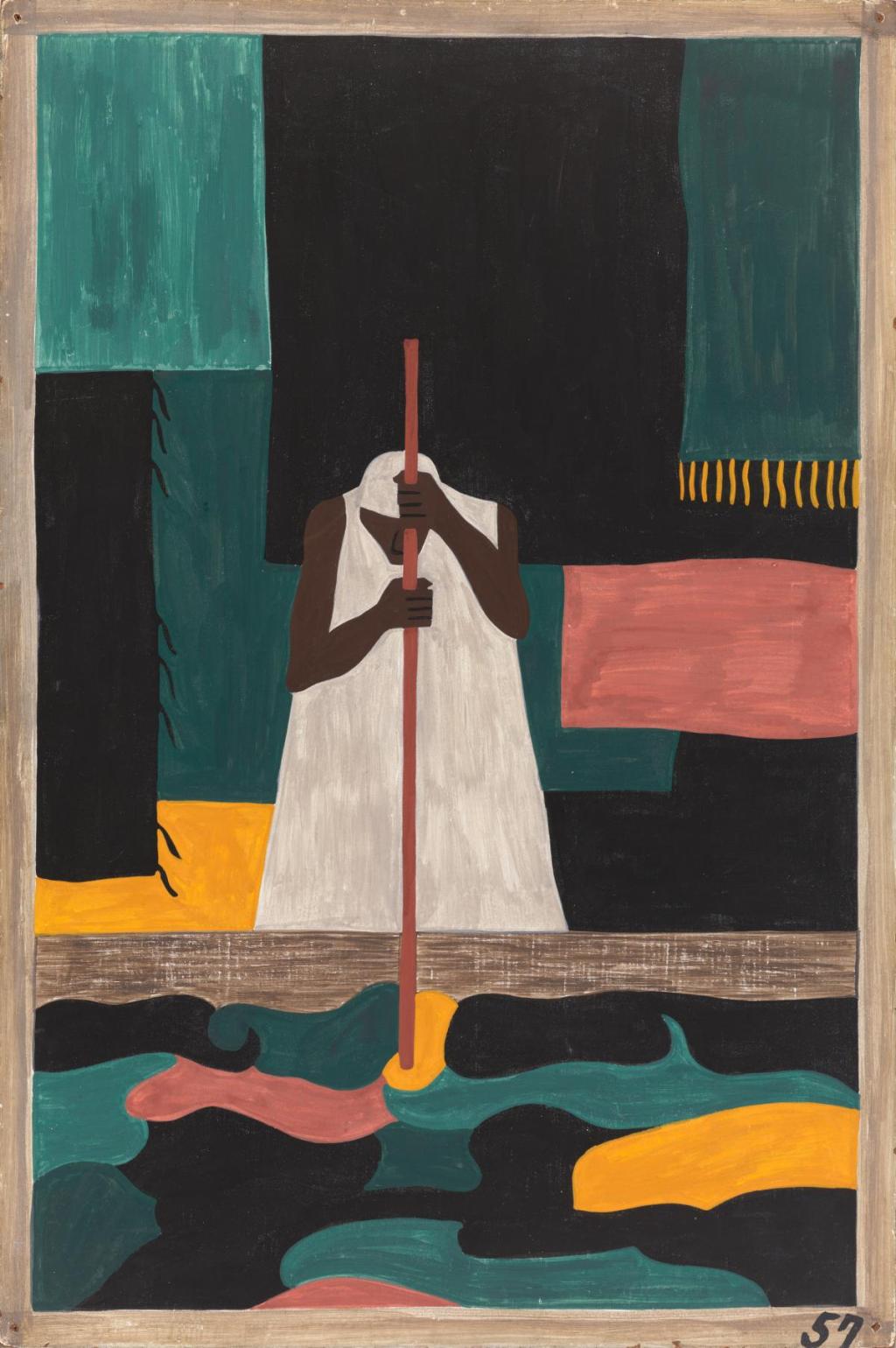
In the 2019 novel Girl, Woman, Other by Bernardine Evaristo, Bummi moves to Britain with her husband Augustine. She’s a graduate in Mathematics, while he’s completed a phD in Economics. They’re both from Nigeria, and while looking for work befitting their education, their applications are regularly rejected. So, she works as a cleaner, and he as a cab driver. Their life in England comes as a deep disappointment. Before migrating
she did not know that (…) her first class degree from a Third World country would mean nothing in her new country
especially with her name and nationality attached to it
Evaristo (2019), Girl, Woman, Other, p. 167
In light of their difficulties, the couple decide not to give their daughter a Nigerian middle name (although later on, as Carole chooses to ignore her cultural heritage, Bummi reminds her that she is Nigerian, “No matter how English-English” – p. 158 – she pretends to be). Bummi’s and Augustine’s life is not easy: they work hard, they eat rubbish, until Augustine dies of a heart attack, and Bummi is left to fend for herself and their daughter Carole.
I’d like to ask my readers if they somehow can relate to that. Think about all the people you know. Start with your family, then your friends, then your acquaintances. Think about their background: what school or university they went to, what country they come from, are they well-off? Now, think about their career: what do they do for a living?
Then ask yourself, to the best of your knowledge, did those people ever choose to do what they do now? I mean, you hear about established surgeons having a change of heart and deciding to move to the countryside, where they milk cows and work as poultry farmers. But, if that is not your circle’s case, is there any other way you can explain the way your family, friends, etc. make a living?
I’ve been thinking about that a lot, lately, as a close relative divorced and couldn’t make head or tails of how to survive without her ex-husband’s income. She does have an education, only she has never really worked, so she started picking up random jobs, the kind of job nobody wants. One evening, as we were chatting in front of the fireplace at my granny’s house, she smiled sadly at me and told me how ridiculous it must look, that a once very spoiled and very fussy girl would go on to clean people’s buttocks for a living as a grown woman. To me it didn’t look ridiculous in the least. Mind you, we’re not talking about the job per se, which could very well be someone else’s chosen career. No, the fact that she doesn’t have a choice is what matters here.
From what I gather by listening to the comments and questions I get at family get-togethers, no one really ever expected me to work. And with that I mean that yes, of course, in my relatives’ opinion a woman should do something with herself. Something part-time, to be able to keep her apartment running, with nice food, clean floors and fresh-smelling laundry. In fact, that something should help her find a suitable man, and make sure she keeps him. If her salary isn’t enough, never mind. She’s not supposed to work to support herself, anyway. At least, not for long. So I asked that relative of mine: what exactly did you expect?
I asked her to look at the women her age in our village and see how many were able to find work without their families’ vouching for them, or just support themselves without a man’s income. Eventually she agreed with me: Life sucks already because we die and all, and it sucks even more if your survival depends on someone else’s whims.
But today’s post is not about my somewhat obsolete village. That would deserve a post on its own. It is about our own expectations and bias towards certain groups of people and the kind of job they should be doing. The kind of bias that takes away their freedom of choice. Let’s take women in general: most of them are employed in the caring professions, and usually they care for the elderly or the children in their families with no pay or recognition whatsoever. Another traditionally acceptable job for a woman is that of teacher, which explains why Faculties of Humanities, Education and Social Science are predominantly female, while women in IT and Engineering are a minority – even though more than half European graduates are actually girls (Key figures on Europe – Eurostat, Sept. 2021). Also, they are still the preferred workforce for domestic service.
Remember domestic service? It’s been a while. Let’s be honest: the research I’ve done for this post dates back to December, which is when I’ve written most of it. So even I have trouble recollecting all the details. Let’s just point out the simple fact that domestic work remains predominantly a female matter, and things didn’t get better with the pandemic (OECD December 2021). The OECD Contribution Caregiving in crisis: Gender inequality in paid and unpaid work during COVID-19 from December 2021 points out that “women have historically spent almost twice as much time in unpaid work than men throughout the OECD” (p.10), a statement based on an estimate of
daily time spent on unpaid work, such as routine housework, shopping, care for household members, childcare, adult care, care for non-household members, volunteering, travel related to household activities, and other unpaid activities, in minutes per day, by gender
OECD Contribution, 13/12/2021, p. 10
You know what historically means. It means it didn’t originate from the pandemic.
On a happier note, paid domestic work is thriving too. In Tranberg Hansen’s words, it is far from going extinct. It “persists, if not grows, in many developing countries as well” (Tranberg Hansen, 1989, p. 293). Of course, domestic servants have evolved over time. Here’s Tranberg Hansen’s categorisation of these new workers:
Some are the wives of unemployed husbands. Others are workers who themselves are laid off after closures of manufacturing plants and who have been unable, or are unprepared, to find new jobs (…) Some are unskilled women trying to earn an income for their households or supplement a social security check; others are minority women who face discrimination in the labor market because of race, sex, and sometimes lack of education. Finally, there are the recent immigrants, some without legal documents, who find in paid household work a hard-earned solution to the problem of making a living (…) Some of them are trained as teachers or nurses but because of their illegal status they cannot seek work in these fields.
Katzman (1978), p. 46 in Tranberg Hansen (1989), p. 296 / Nakano Glenn (1986) in Tranberg Hansen (1989), p. 296
I know what you’re thinking: this report dates back to the 80s. Yes. But don’t “Stagnation and unemployment (…) Large trade deficits, huge debt burdens, and regional disparities” (Nash 1983 pp. 3-38, in Tranberg Hansen 1989, p. 295) ring a bell? The author further explains that most people employed in this line of work at the end of the 1980s are women, and they mostly do cleaning or babysitting. In an ever-growing capitalist society, these jobs have become subject to strong competition dynamics. Many hiring families would now expect their employees to have specific qualifications, because, as a matter of fact, there are courses and schools claiming to turn people into professional cleaners or nannies. They are not held for free, though, and while a professional has good employment prospects, someone lacking the financial means or language skills necessary to get that kind of qualification would easily find themselves working in less appealing conditions, possibly with no contract to claim and protect their rights. Does this ring a bell? My point being: wherever there’s uncertainty and migration, this scenario applies. Whether this is the consequence or the root cause of our cultural expectations and bias, whereby we expect immigrants from poorer countries to be exploited, and even be grateful to be given any job, I cannot tell for sure. I suppose it’s a vicious circle, where beginning and end are never clearly in sight.
Bummi’s story provides a telling example. That it is fictional doesn’t really matter, as I’m sure many people’s lives are very similar, only they didn’t have a chance to write an autobiography. In one of my favourite passages from the book, after the death of her husband, Bummi complains “that people viewed her through what she did (a cleaner) and not what she was (an educated woman)” (Evaristo 2019, p. 167). In order to support her daughter, as wells as out of self-respect, she decides to start her own cleaning company:
she asked herself – do I not have a degree in Mathematics? (…) do I not enjoy the challenge of problem solving?
(…) that night she dreamed of employing an army of women cleaners who would set forth across the planet on a mission to clean up all the damage done to the environment
Evaristo (2019), Girl, Woman, Other, p. 170
Life is just as difficult for Ifemelu, the main character from Adichie’s novel, Americanah. After moving to the USA, she struggles to find a job, which she tries to do by using someone else’s social security number. For a while, the only offer she gets is by a tennis coach, who would like to hire her as an assistant to help him “relax”. This sadly resonates with yet another detail from Tranberg Hansen’s account of domestic service. According to the author, in some African areas with European presence up until the 1980s (though probably even later) white women were reluctant to hire African women in their households, because of the long history of abuse the latter had been subject to in the colonies, which accounts for them always being “viewed in sexual terms” by their employers (Tranberg Hansen, 1989, p. 300). Eventually, Ifem does accept the job offer, in order to pay the bills. She takes full responsibility for her choice: “he did not force her” (Adichie 2013, p. 154), and struggles to recover from depression for a long time afterwards. So, was it really her choice?
Dear reader, I apologise. I had actually planned this post in a different way. I wanted to give a complete and thought-provoking account of domestic service, which ideally would make you doubt and question the social structure and division of labour as we know them. The truth is, it is not complete. I’ve been rambling about bias and domestic work and I hope you got the point, which is quite simple: don’t be biased. Make the world a better place.
Bibliography & sources
Adichie, C. N. (2013). Americanah. London: HarperCollins Publishers
Eurostat (2021). Key figures on Europe. Imprimerie Bietlot / Publications Office of the European Union
Evaristo, B. (2020). Girl, woman, other. London: Penguin Books.
Glenn, E. N. (1985) Issei, Nisei, War Bride: Three Generations of Japanese American Women in Domestic Service (Philadelphia: Temple University Press, 1986). In: Tranberg Hansen, K. (1989). Servants Everywhere: Conclusions. In: Distant Companions: Servants and Employers in Zambia, 1900–1985, Cornell University Press, pp. 293-302.
Katzman, D. M. (1978) Seven Days a Week: Women and Domestic Service in Industrializing America (New York: Oxford University Press, 1978), p. 46. In: Tranberg Hansen, K. (1989). Servants Everywhere: Conclusions. In: Distant Companions: Servants and Employers in Zambia, 1900–1985, Cornell University Press, pp. 293-302.
Lawrence, J. (1940-41). The immigration series, panel 57: The female workers were the last to arrive north. The Phillips Collection,Washington, DC, Acquired 1942
Nash, J. (1983). The Impact of the Changing International Division of Labor on Different Sectors of the Labor Force. In: Women, Men, and the International Division of Labor. Albany: State University of New York Press, 1983), pp. 3-38. In: Tranberg Hansen, K. (1989). Servants Everywhere: Conclusions. In: Distant Companions: Servants and Employers in Zambia, 1900–1985, Cornell University Press, pp. 293-302.
Organisation for Economic Co-operation and Development (2021). Caregiving in crisis: Gender inequality in paid and unpaid work during COVID-19. URL: https://read.oecd-ilibrary.org/view/?ref=1122_1122019-pxf57r6v6k&title=Caregiving-in-crisis-Gender-inequality-in-paid-and-unpaid-work-during-COVID-19 (accessed on 4.02.2022)
Tranberg Hansen, K. (1989). Servants Everywhere: Conclusions. In: Distant Companions: Servants and Employers in Zambia, 1900–1985, Cornell University Press, pp. 293-302. URL: https://www.jstor.org/stable/10.7591/j.ctt207g71p.13 (accessed on 19.12.2021)
 Puellae in Fabula
Leave a comment