Welcome back to our feature of free rein thoughts over harmless literary products. Long time no read, I hope you didn’t miss it too much.
I personally haven’t. Deep, intricate thoughts are fun but they can easily become addictive, before leaving you to deal with the long gone world you have created, lingering in your head, whilst neglecting your present self.
But if you are on the lookout for some thoughts to fry, here my two cents for you.
In our previous post, the example of birth control gave the opportunity to interpret the role of science and logical research in society. By blending historical facts and new scientific discoveries, we scratched the surface on the bias we (un)consciously have. While we go on living our average lives, it’s hard to face the fact that one simple thought could cause a progressive shift in other people’s reality. It’s even excruciatingly harder to realise that the words we use to embody those thoughts can determine a whole world of violence, as they could mean peace.
I’m not here arguing if scientists in all era and corners of the world reached this very awareness, with this post I would like to face my own bias instead, starting from a closer field than the laboratory one.
Noli me tangere – body and control
I have been lucky enough in this life to be friends with some smart ass people. The kind of individuals inclined to the selfless investigation of the Truth, to boundless sharing and not a day where they wouldn’t use their precious insight to put you at ease with your own ideas.
That was the spirit, I guess, when this brilliant friend of mine asked me what was my relationship with spirituality and, more specifically, whether it was possible for me to conciliate my faith with the contradictions brought about by the institution that should represent it.
If you haven’t guessed it yet, allow me to be crystal clear and reassure you that no priest or nun has been ill-treated for the purpose of this post.
I’m catholic, and so is my family, just like the 50ish percent of the Italian population.
I haven’t had an exceptionally exciting life nor an extraordinary religious experience, but having been through the whole ritualistic cursus honorem, from baptism to confirmation, I have in fact attended quite a few Catholic-oriented environments (at the moment I’m following a couples of very interesting accounts on IG just FYI). As a kid, it very quickly grew on me that the church would have always been part of my daily life, especially since I kind of have a soft spot for the idea of community and cooperation, people gathered in order to achieve a common good.
Growing up, it turned out that human groups are as problematic as they can be extremely welcoming in their effort to provide a useful and relevant service for the community. That’s kind of experience I have had with mine as well, which led me to recognise existing issues aside the numerous perks.
All this intricate thinking came to my mind as a close friend, during our lighthearted literary meetings, asked me about my Catholic experience. She was specifically inquiring on my way to deal with the church contradictory views on family and abortion.
With abortion, the contrast of intentions and outcomes becomes staggering clear and for a religious person it’s challenging to find a balance, especially when the debate seems to assume the traits of a football match, with the “we” against “them”.
So I did what appears to be what I do best, which is studying with the puellae.
As a matter of fact, the issue of control on people and bodies is quite a common one in our sessions. However, I came to terms with it officially while addressing the story of saints Brigid of Kildare, Ciarán of Saigir, Cainnech of Aghaboe, and Áed mac Bricc: these Irish saints all have abortions recounted among their miracles. In the past, in fact, abortion went as far as being recommended and even encouraged when the father was supposed to be a criminal, or in cases where a nun had been raped. Far from having the women’s it resent in mind, the church did not stop there in its attempt to maintain control over bodies and society. Around the 14 and the 16 century, the most eminent archibishops and popes expressed their concerns in defining the right time to get an abortion, which would ideally be in the moment before the soul had been present in the foetus. This passage appeared to be quite relevant since intervening over time would have been considered a sin, and being an act of soul killing, it was the worst sin possible as the Commandments very straightforwardly specify. The obsession with sin sure isn’t surprising nor is it any news. But this story raised a question in me: if catholic institutions have all the interest in defining right and wrong, then there should be at least a similar commitment with the appropriate timing to get rid of a foetus. And maybe, you would expect such clear-cut positions with other moral dilemmas.
However, it wasn’t up until recently when I have realised that such accuracy in defining right and wrong is hardly found in my religion. More accurately, the shared concern seems to be having to do with what is acceptable and unacceptable. “For whom?” you may ask.
If you are curious, here the thoughts I have given birth to (pardon my pun):
- The Body hierarchy
The Catholic Church, just like the churches of other monotheistic religions, has a clear idea of the soul and the travel it goes through in order to reach the higher spirit. This travel is not just a spiritual one, it doesn’t just happen in your mind but has to be embodied by your actions, otherwise you are committing the sin of simony. So, in this sense, the body is not simply the shell of the soul, on the contrary it completes it and makes it real and valuable. On the other hand though, the body is what makes us vulnerable as well. The body we get when we are given the gift of life exposes us to dangers and sins and can even have the power to annihilate the soul, if we aren’t careful. After all, Jesus didn’t just give his people the spirit, but especially his body, and that’s what the miracle is all about: the body of a men, his scars and phlegm, a weak, armless person with the Father’s strength, to save us all.
It seems to me that this very idea has been neglected if not completely overthrown, while addressing abortion and women’s (humans’) rights. My idea is that behind the curtain of the catholic merciful charity there is the skeleton of a Body Hierarchy.
The structure of the catholic community is built on a pyramid, at the bottom we find the so called assembly, while progressively ranking to the top we have the bishops and then the big shot, the Pope.
This state is not imposed, maybe not even explicit, it is nonetheless accepted by those who take part in it, perfectly are conscious of their place. What has struck me recently is that church members with high ranking are also those more detached and far from the crowd’s reaching. The Pope, the archibishops and even the towns’ curia are basically untouchable. You may kiss their ring if you have to, maybe even give a sign of peace, but there it is.
On the contrary, the assembly, the average folks, the laic ones are at disposal and as such they are at the bottom of the pyramid. Their bodies are not far entities covered up by a sainty aura. It may be strange to immagine it if you are not familiar with the Catholic Church, so I’ll give you some further example of what I’m getting at.
My mum used to tell me how my grandma wasn’t allowed to the service after giving birth because she was considered stained, so she had to wait in order to make her body “pure” again.
My grandma, on the other hand, made it very clear to me that I wasn’t supposed to eat ostia with my teeth or that would have been a sin during my communion ceremony. Two completely different episodes that share the effort by the church of actively controlling what other bodies do (I‘ve yet to find the passage in the Bible where such beliefs are shared).
To be fair, time has passed, and overly superstitious beliefs such as those have been rooted out, but that doesn’t mean that body obsession isn’t over, especially bodies who tend to escape control. One way or the other, whether it is a matter of protection or a soul-saving scenario, abortion and control on women’s body is extremely relevant for the catholic church. so much so, philosophers and essayists Edoardo L. Vallauri et al. go as far as stating that control from the Roman church pervades our society influencing even those who profess themselves as atheist or non religious.
In this research, the idea of a monogamously moral society controlling our actions, thoughts and desires is being advocated. The Church in this perspective stands as the moral code provider: you might not share its views or you might even refuse it, but you know it’s there and someday you might even need it, for example to make your wedding official and tasteful.
Now, I hope you won’t consider me as naive as to have expected a pro choice from one of the most enduring monotheistic religion. I did expect at least some compassion though given the stress it has always been put on mercy and humbleness. I am quite satisfied in saying that eminent religious women such as Caterina da Siena, in a context where the voice of women was not only ignored but utterly excluded from the public, managed to stretch the limits inherently involved in the christian paradigm of Mercy. What is it worth if it is not shared to the most humble, the poorest and weakest individuals of society? In 14th century Tuscany, those individuals where mostly women. As a way to advocate for her role and ideas in a male, highly hierarchical environment, is wasn’t unusual for her to be pictured as a matron on a glorious throne, whilst sharing knowledge with other women (usually princesses, but still).
However, these interventions were mostly considered exceptional and were soon to be adapted to a more acceptable idea of saint women: meek, compassionate and quiet.
Which brings me to my next reflection
2. Poetic schizophrenia
“May those responsible for the wealth of nations protect the dignity of human life from the mother’s womb by preventing abortions, because every child who is born is God’s glory.”
This was the prayer said during the Christmas service that gave me the courage to write this post, however imprecise it is.
That was the exact moment when I realised the schizofrenia that cult can get us into. On the one hand, we are thought to, to forgive and ask for forgiveness, on the other, the institution that should represent the assembly is the one accusing and attacking it.
It would be misleading of me to not mention the stunning verses that come from the Bible, here is one of my favourite:
<<The very stone which the builders rejected has become the head of the corner>> (Mt 21: 42).
What it means is that the church was built on the poorest, most forget and neglected piece of man that could be found, it’s the voice of the unheard and the support of the mistreated.
Now the catholic institution is pointing the finger against the neglected and mistreated, it is perpetuating the abuse while going on professing Mercy.
Where does the truth lie? I want to believe that, like in all human contents, so in religious environments both good and evil sides thrive, the difference is made by those who are determined to investigate with patience and strength, even when the very fact of not being content with the given answers makes you doomed to lose.
Bibliography
https://www.famigliacristiana.it/media/pdf/domenica/do2160_multipagina_00.pdf
http://www.teologheitaline.org
https://podcasts.apple.com/it/podcast/palinsesto-femminista/id1527732583?i=1000554755253
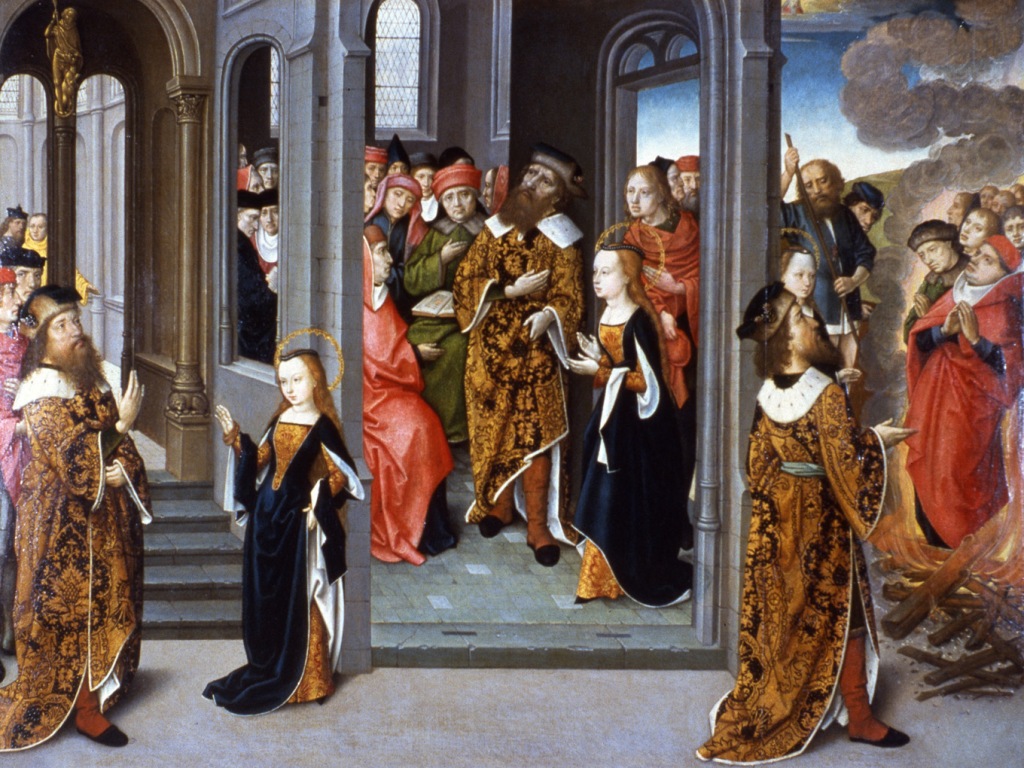
Picture: unknown Flemish artist, end of the XV century (1480), Storie di santa Caterina d’Alessandria
olio su tavola.
 Puellae in Fabula
Leave a comment