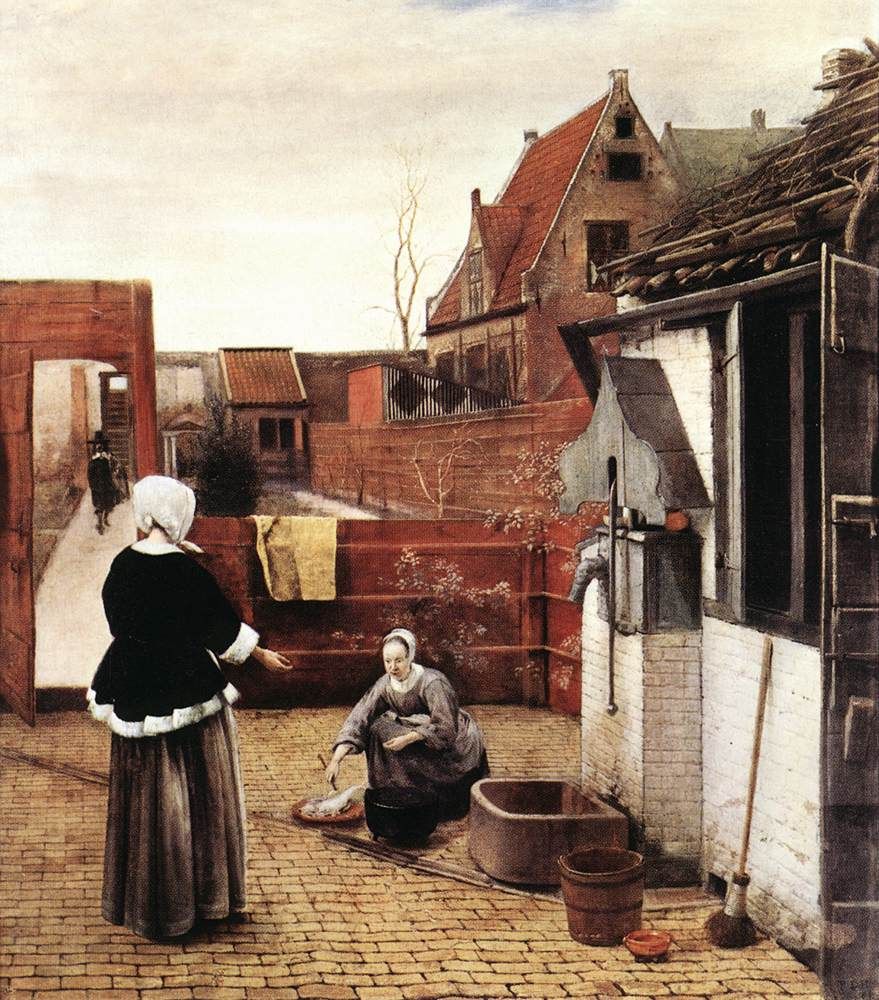
I’m not gonna lie. I like Downton Abbey. I even watched it twice, and the fact that people thrice my age love it too didn’t put me off in the least (I’m a great fan of Angela Lansbury, just saying). I have often wondered how plausible the series is, and I’m not talking about the intricate romantic plots. No, I’ve given up on those. You see, it’s the details from everyday life I find very intriguing, and even though the sophisticated Crawleys per se are interesting – although, let’s face it, they’d be nothing without Maggie Smith – , it’s the servants that fascinate me.
If you watched the show, you’d know that the Crawleys are liberal people who generally treat their staff fair and square, so much so that the servants seem to have a little time to enjoy themselves, build relationships, learn other skills and trades, and so on. I had the strong suspicion that in actual fact, for most servants at the time, this might not be the case. So, I did what I do best: I watched a documentary. I’ll put the link in the sources at the end of this post. In it Pamela Cox gives us a real and detailed account of what life as a servant was like and I’m telling you, it ain’t pretty.
Servants in the Victorian age were working class people, although occasionally they might come from the impoverished nobility, and in that case they would occupy better positions, such as butler, housekeeper, governess. A servant worked 7 days a week, as long as he or she was awake, meaning that they would perform their duties for a 17-hour-long day. At the very bottom of the ladder you’d find the laundry maid, the scullery maid, and the hallboy. One such maid would be expected to work from 5:00 in the morning until 10:00 in the night. Every minute had to be accounted for, and shirking one’s duties would not have been easy.
Girls had it often tougher than boys. The gap in wages between male and female servants was significant, and a further difference was, of course, accounted for by rank. During the late 1800s, while a valet earned around £52, a lady’s maid wages were only half, although the job came with the same prestige. A laundry maid could expect £18, while a nursery maid earned a miserable 9 guineas (maybe they were better paid in some households, but these numbers are in line with the market standards). The male staff would receive their uniforms from their employers, whereas the female servants had to make their own uniforms – the employers probably reckoned it wouldn’t make much difference, since the girls had to sew and knit anyway. Girls and boys often started their career very young. They were usually less well-fed as they came from poor families, and sometimes either they had been abused at home or they would be while in service, or, why not, they were abused at home and at work for good measure.
Imagine being 11 years old and spending the whole day and part of the night dusting, scrubbing the floor, peeling potatoes, sweating in the laundry steam, stripping beds, carrying upstairs and downstairs heavy buckets filled with anything – hot water for the master’s bath, or the content of everyone’s chamber pots and bedpans, which you yourself had to empty (and you weren’t even wearing rubber gloves). Imagine doing all that every day, all year round, and getting paid that much. And having to make your own uniform, to add insult to injury. No wonder people started turning to factories, shops, anywhere but domestic service. So, the wealthy resorted to social reform to make sure they got their fair share of servants, as well as their clean conscience. Yes, because servants were of paramount importance, for two main reasons:
1. to show off one’s position
2. for the very survival of the rich
and when I say survival, I don’t mean metaphorically. I mean that it was thanks to servants that their employers stayed alive. In her review of Lucy Lethbridge’s book, Servants: A Downstairs View of Twentieth-Century Britain (2013), Lara Feigel writes:
The Edwardian viceroy of India was faced with the challenge of opening his bedroom window after the servants had gone to bed. Baffled but indomitable, he picked up a log from the grate and smashed the glass. Forty years later, Winston Churchill’s valet was unimpressed to find that the former prime minister was incapable of dressing himself without assistance.
Lara Feigel 25.03.2013, The Guardian
Homes were set up for children who had nobody to care for them, where they would be trained to become domestic servants. The same was done for fallen women, i.e. unmarried women who had relationships with men. They, too, were trained to become maids. In Margaret Atwood’s novel Alias Grace (1996), the main character, a former servant accused of murder, compares well-off men to children, since they are never held responsible for “the messes they make” (p. 249). And they would make a lot of mess. Fallen women were often victim of rape while they were in service at the hands of their employers. As Mary Whitney tells Grace, trying to warn her:
There are some of the masters who think you owe them service twenty-four hours a day, and should do the main work flat on your back.
Atwood, M. (1996), Alias Grace, p. 231
Mary herself ends up pregnant and undergoes a clumsy attempt at surgical abortion, which results in her death. I suppose one should have been very grateful for being taken in and taught a skill, for another chance to have a normal life, one that is acceptable. However, it seems to me that these efforts were only aimed at preventing social change. Social mobility wasn’t part of the deal. These people were trained to occupy the bottom of the ladder, and be content with their lives as they were. Even though it meant bearing the brunt of their masters’ vanity or lack of self-control.
Downton Abbey depicts the employers as caring and involved in their servants’ lives. The truth is, anonymity and invisibility were part of the job. Not just because the servants’ quarters were completely segregated from their masters’ (and from each other’s, depending on rank, gender etc.), but more often than not a big household head would have no idea how many people he employed, let alone what their names were. And it isn’t simply that the two sorts of people wouldn’t mingle, they wouldn’t even see each other. Big houses, like the Crawleys’, were equipped with secret doors and passages and back stairs to relieve the employers from the pain of meeting their staff.
One type of servant was the most invisible of all: the coloured one. There are very few mentions of black servants in the 1800s in England. A few were employed as household staff after escaping slavery, and although they were free, their past as slaves lay heavily on them. Alan Rice in his chapter about Lancaster’s involvement in slave trade refers to Eliza Dear, descendant of slave traders, who in turn wrote about a mummified black hand which her family had been keeping since the 19th century, and which “belonged to someone’s favourite slave” (Dear, E., 2000, p. 3 in Rice, A., 2020, p. 188).
It is not hard for us, western people of the XXI century, to understand what entitlement to ownership is. What appears unthinkable, though, is that someone might see themselves as entitled to own a human being, so that keeping their limbs for display on the fireplace is no big deal. Probably there aren’t many people left who would do such a thing. But, I’m sorry to break it to you, dog days are not over, no matter what Florence Welch says. Yes, domestic servants, in time, like other workers, got better pay and better working conditions, but this stupid class/gender/race distinction didn’t end there, and to this day one’s job often still depends on class, race and gender. Of course, every country is different (you can’t deal with the whole world at once, can you?), but the discrimination dynamics are similar everywhere, and everywhere they feed into work bias, among other things. Which is what we’ll talk about next.
Bibliography & sources
Atwood, Margaret (1996). Alias Grace. London: Bloomsbury Publishing
Cox, Pamela/Hindley, Emma/Hobley, Annabel (2012). Servants: the true story of life below stairs. URL: https://www.youtube.com/watch?v=wqiMASk5MIU&list=PLQNKYiRF6H6EdmeiydPTGMArfuhNnFwkS&ab_channel=anarchi.st (accessed on 1.12.2021)
Dear, Eliza (2000). In celebration of human spirit: a look at the slave trade. Settle: Lambert’s Print and Design, p. 3. In: Rice, Alan (2020). Ghostly Presences Servants and Runaways: Lancaster’s Emerging Black Histories and their Memorialization 1687–1865. In: Gerzina, Gretchen H. (2020). Britain’s black past. Liverpool: Liverpool University Press, pp. 179-196. URL: https://www.jstor.org/stable/j.ctvz937c0.15 (accessed on 14.12.2021)
De Hooch, Pieter (1660-1661). A woman and her maid in a courtyard. London National Gallery
Feigel, Lara (2013). Servants: A downstairs view of twentieth-century Britain by Lucy Lethbridge – review. The Guardian. URL: https://www.theguardian.com/books/2013/mar/25/servants-lucy-lethbridge-review (accessed on 15.12.2021)
Hopley, Claire (2021). The real Downton Abbey. Servants’s lives below stairs. British Heritage. URL: https://britishheritage.com/history/servants-lives-below-stairs.amp (accessed on 10.12.2012)


 Puellae in Fabula
Leave a comment